Exploring my favourite Quito on a Wheelchair
September 16, 2026
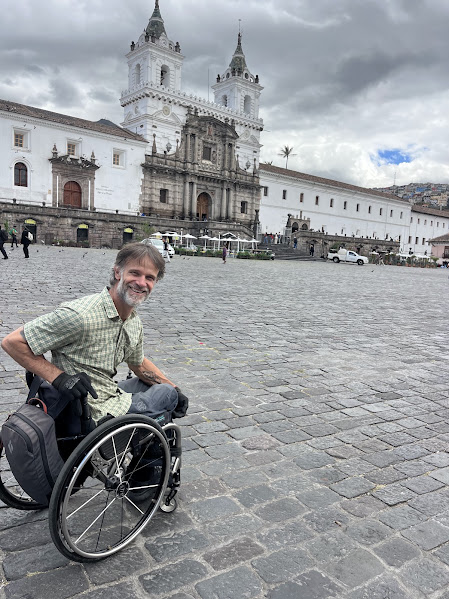
This exploration of my city is part of a new project with my friend Pepe Nico, founder of Apu Climbs. It's a personal and professional opportunity for me, and a new job possibility for many others. Tourism is a way to learn, connect, and experience the city from within, and when it's accessible, it becomes a right: for seniors, families with babies, people with physical, visual, hearing, or cognitive disabilities, and also for those recovering from a temporary injury or using mobility aids. Quito has everything to captivate—its history, its culture, and its beauty—and for that charm to reach everyone without exception, we need the city to be truly accessible: with safe routes, clear information, well-designed infrastructure, and inclusive services. With this project, I want to contribute to making tourism in Quito a possible experience for everyone, without barriers.
Having a disability in Quito is a challenge. And getting around in a wheelchair isn't just about "getting around": it's about experiencing an adventure every time you go out, anticipating obstacles, finding routes, measuring inclines, and often, asking for help.
I've been using a manual wheelchair for 11 years now. And one of my biggest motivations is finding ways to make my city as accessible as possible for everyone: not just those with physical disabilities, but also those with visual, hearing, or cognitive impairments. It also needs to be accessible for seniors, families with strollers, and people recovering from a temporary injury who need a walker or crutches.
Unfortunately, many of these conditions are beyond our control. What we can change are the barriers: those obstacles that prevent a person with a disability from moving freely, enjoying life, and participating like anyone else.
Inside Quito: Beauty and Barriers
Quito's Historic Center is one of the most beautiful places in my city. But there's a detail that's sometimes forgotten: the conquistadors (or anyone else) didn't think about wheelchair accessibility more than five hundred years ago.
Today, that lack of planning is evident in the streets, the sidewalks, the shape of the corners, the old stonework, and above all, the topography. Quito sits on the slopes of the Pichincha volcano, which means steep inclines. Even so, it's worth venturing into the city center in search of the best possible access route.
The accessible route: By Metro to the heart of the Center
Luckily, we have the subway today, and that makes a big difference to the experience. This time, we left from the La Carolina station and went to San Francisco. From there, we began the uphill climb.
The first part was a moderate incline on relatively smooth ground; rolling with a wheelchair, although challenging, allowed me to move forward with some control. Then we arrived at San Francisco Square.
At this point, it's best to stay on the eastern sidewalk. The plaza's sidewalk is old and has colonial-era buildings that look beautiful—and that's true—but they also make passage much more difficult and less safe for wheelchair users.
Going up through Benalcázar and Cuenca: a "rideable" stretch
After crossing into the Benalcázar area, we continued uphill to Simón Bolívar. From there, we turned left onto Cuenca Street until we reached the Alabado Museum.
This section is generally rideable: the sidewalks have ramps at the intersections, and the surface is easy to navigate. Even so, the moderate incline is noticeable, and in more than one part I needed my buddy Pepe Nico to give me a little push. He also enjoyed the exercise, so it was a shared experience for us.
Alabado Museum: history, beauty and opportunities for improvement
The Alabado Museum is beautiful. It has truly impressive historical pieces, and it's housed in a renovated 400-year-old building. That blend of history and culture is palpable from the moment you step inside.
In terms of accessibility, it's generally quite good. However, there are still some details that could be improved, especially the slopes of the ramps. In particular, the entrance ramp is around 15% steep and made of stone, which can be very difficult for many wheelchair users. I understand that it's a colonial material and style, but precisely for that reason, accessibility should be addressed with creative solutions without compromising the building's heritage value.
How long should I spend visiting the museum?
The tour can be adapted to each person's pace. In my experience, I recommend doing it in an hour and a half, and then enjoying a coffee or fresh juice at the café afterward. It feels like a relaxing and pleasant way to end the outing.
Return: Hotel Casa Gangotena and a view worth the trip
After visiting the museum, we returned along Cuenca Street to Simón Bolívar Avenue, passing by the Casa Gangotena Hotel. It's worth going inside: climbing to the terrace and enjoying the view of San Francisco Square is a huge reward after the hike up the hills.
What's missing: accessibility for the Church and Convent of San Francisco
Finally, there's one thing that still needs addressing: there's currently no ramp for easy access to the Church or Convent of San Francisco. I hope improvements will be made soon, because it's an important place and should be accessible to everyone. It's true that colonial architecture is part of our identity and heritage; we must care for and value it. But precisely because it is heritage, it's worth understanding that accessibility can also be part of that care: it's not about "breaking" the colonial style, but about incorporating solutions. For example, replacing three colonial steps with a ramp built with the same materials and in the same style can open up a great opportunity for many more people—such as seniors or people with reduced mobility—to access this beautiful church. Because in the end, what is more important: maintaining colonial steps or giving everyone the opportunity to visit this place?
An invitation to continue building the city
These kinds of outings remind me that accessibility isn't an "extra." It's dignity, it's autonomy, and it's the possibility of enjoying the city without feeling like every outing depends on luck.
Quito is beautiful, and the Historic Center is a cultural treasure. But for it to truly be for everyone, we need to continue removing barriers: planning routes, adjusting slopes, including appropriate ramps, and improving spaces where wheelchairs, walkers, or people with reduced mobility still encounter obstacles.
If you're also visiting Quito, I invite you to look beyond the scenery: observe the route, recognize what's accessible, and also point out what's missing. Together, we can help make our city more humane.